Dental implants are the closest you can get to healthy, natural teeth. With them you can eat, smile, laugh, talk, kiss and get on with your day without worrying about your teeth.
How an implant works
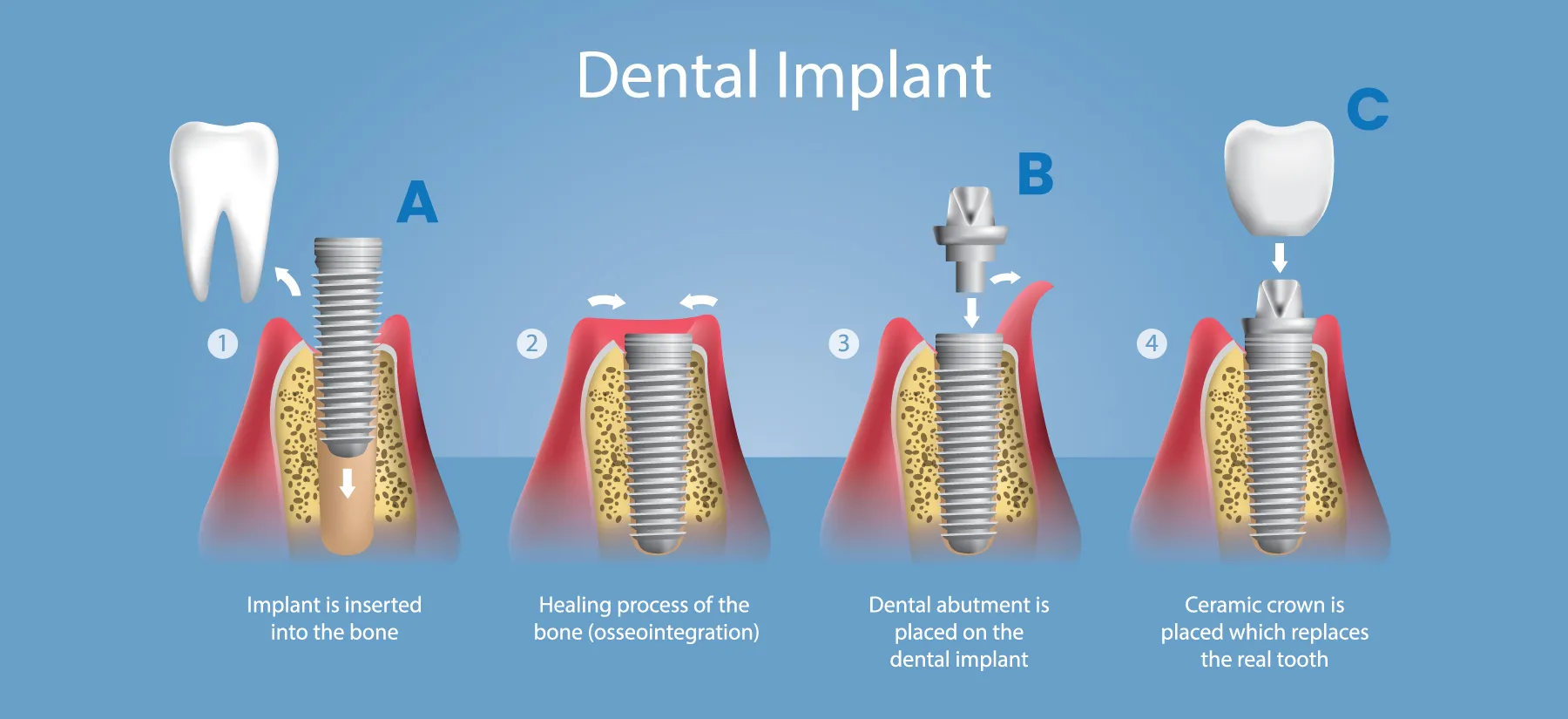
An implant is an artificial tooth root, shaped like a screw. It is placed in your jawbone (A), where it bonds with the bone. It then becomes a sturdy base for one or more artificial teeth, called crowns.
A connector called an abutment (B) goes on top of the implant to hold the crown. Each crown is made to match your natural teeth and fit your mouth (C).
Implants are the strongest way to support replacement teeth, and the new teeth look, feel and work like natural ones.
Done by a trained, experienced implant dentist, implant surgery is one of the safest and most predictable procedures in dentistry.
Does it hurt?
You shouldn’t feel pain during the procedure, because you’ll have anaesthesia. You may feel some discomfort afterwards. It usually fades within a week or two, along with any swelling. If you need them, your dentist can prescribe painkillers.
How long does it take?
Every patient is different. After your first consultation, your dentist will give you a treatment plan with an estimate of how long it will take. That depends on your needs, your medical and dental history, the condition of your jawbone, and the technique and materials used. It can take a few months, or more than a year in more complex cases.
Why choose implants
- They look like real teeth.
- They don’t affect the teeth next to them.
- Unlike dentures or aligners, they never need to come out.
- They need less upkeep than dentures or aligners.
- They last for life, even longer than natural teeth.
- The surgery has a high success rate.
- You can eat anything you would eat with natural teeth.
The cost
The one drawback is that implants cost more upfront. If they fit your budget, they are the best way to replace lost, broken or damaged teeth. You can spread the cost with interest-free instalments on your credit card, or with The Smile Clinic’s own interest-free repayment plan.
In the long run, implants cost less than dentures or bridges. They give results straight away, and you look after them like natural teeth, which keeps the cost down too.
We can tell you whether implants suit you and take care of the whole treatment. Message either clinic, or write to us on our Facebook page.
References: “What are dental implants?”, American Academy of Implant Dentistry; “Dental implant pain”, Authority Dental